As night fell over the campus, the lights came on — and the athletics field atHenan Finance and Economics Universitywas transformed for the biggest night of the year: the"Sparking Finance, Igniting Youth" 2026 Freshman Welcome Gala.
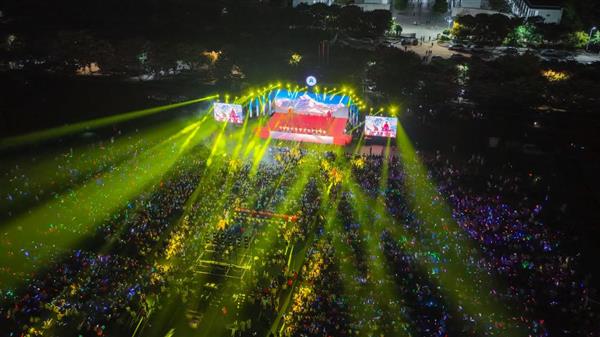
For many students, it was their first night on campus. For the production team, it was a far tougher assignment: a multi-camera live stream, running on schedule, in one of the most unforgiving RF environments a campus can offer.CRYSTAL VIDEO Thunder PRO-Duowas there from first setup to final curtain, delivering rock-solid wireless video every step of the way.
A True Field Test: From Build-Out to Curtain Call
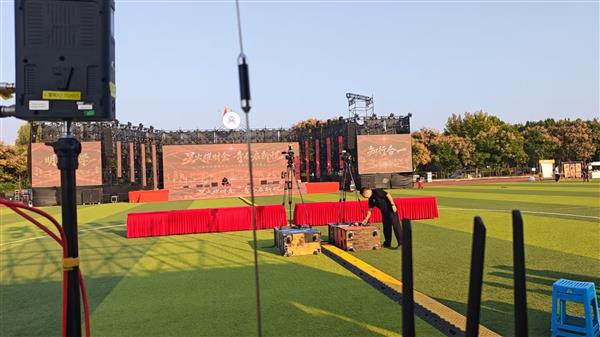
Thunder PRO-Duo didn't just arrive for the show — it lived through the entire day.
The build began under the afternoon sun: a massive truss stage anchored at one end of the field, stacked with tons of steel lighting towers, line-array speakers and a full LED wall running the length of the central axis. By dusk, the track was ringed with thousands of incoming freshmen — glow sticks, phone streams, Bluetooth earbuds and power banks, all fighting for the same slice of spectrum. Then came the cold-spark waterfall over the stage, sending flame and haze sweeping across the camera lenses. Off-field, campus Wi-Fi, carrier base stations and security radios were all broadcasting at once — and with students bussed in from the university's second campus for the event, the 2.4 GHz and 5.8 GHz bands were, frankly,a madhouse.
Then there was the camera plan. A locked-off tripod cam on the turf, a gimbal operator pushing into the crowd, and the production truck parked off to the side — or sometimes behind the action entirely. Between transmitter and receiver: steel truss, an LED wall, a wall of people, and a few thousand phones.
In a venue like this, the real enemy isn't distance. It's occlusion.
A True Field Test: From Build-Out to Curtain Call
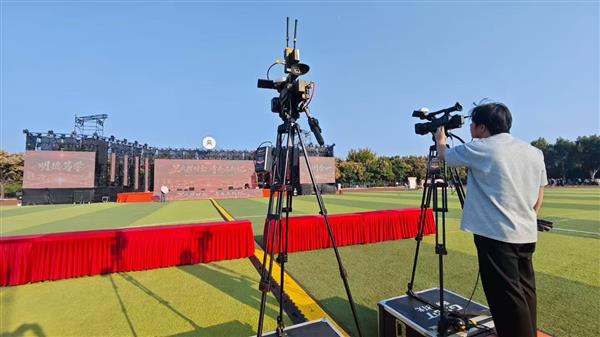
Thunder PRO-Duo didn't just arrive for the show — it lived through the entire day.
The build began under the afternoon sun: a massive truss stage anchored at one end of the field, stacked with tons of steel lighting towers, line-array speakers and a full LED wall running the length of the central axis. By dusk, the track was ringed with thousands of incoming freshmen — glow sticks, phone streams, Bluetooth earbuds and power banks, all fighting for the same slice of spectrum. Then came the cold-spark waterfall over the stage, sending flame and haze sweeping across the camera lenses. Off-field, campus Wi-Fi, carrier base stations and security radios were all broadcasting at once — and with students bussed in from the university's second campus for the event, the 2.4 GHz and 5.8 GHz bands were, frankly,a madhouse.
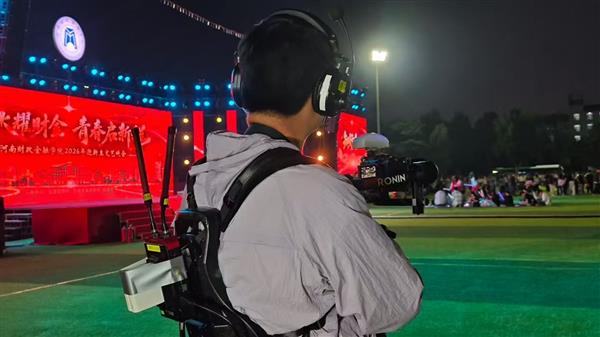
Then there was the camera plan. A locked-off tripod cam on the turf, a gimbal operator pushing into the crowd, and the production truck parked off to the side — or sometimes behind the action entirely. Between transmitter and receiver: steel truss, an LED wall, a wall of people, and a few thousand phones.
In a venue like this, the real enemy isn't distance. It's occlusion.
Zero Dropped Frames, Start to Finish
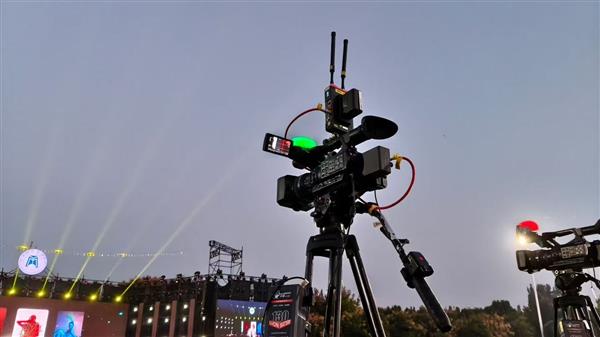
The gala opened withDrumbeat of the Stars, a dance set led by a squad of dancing robots. The director was cutting constantly — tight shots, tracking moves, crowd reactions. The moment a roaming operator turned away from the truck, the antennas were masked by bodies, by the crowd, by the truss itself. On a conventional wireless link, that's where the picture dies: macroblocks, snow, then a hard drop.
Not this night. From the first cable pull at noon to the final bow after midnight,Thunder PRO-Duo never lost lock.
Not luck —penetration and diffraction. When line of sight was cut by truss and thousands of bodies, the signal simply bent its way around the obstruction and landed cleanly at the receiver. Steel, LED wall, roaring crowd — none of it mattered. At the director's monitor, the picture stayed exactly what you want it to be:stable, sharp, no second-guessing.
The whole show ran on a multi-camera setup. Thunder PRO-Duo transmitstwo independent video channels over a single wireless channel, with native HDMI and 3G-SDI passthrough and multi-platform control, so the camera team could stay focused on shooting while the switcher pulled clean feeds in real time. Powered byH.265 encoding at up to 1080p60, every wash of stage color was rendered faithfully, wirelessly, across the field. That quiet, boring kind of reliability is exactly the confidence a campus production lives on.
Why Campuses Keep Calling About This One
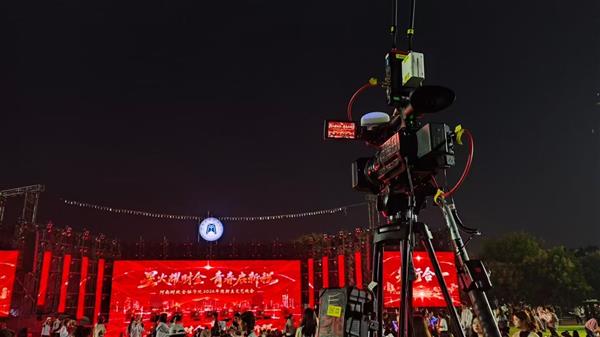
When the last note faded, we walked away with more than a great show. In the weeks since, inquiries have been pouring in from universities across the region — all asking the same thing:
?Blocked by truss & LED walls? Deep penetration & NLOS delivers up to 1,000 m (3,280 ft) even without a direct path.
?Crowded by phones & Wi-Fi? Serious interference immunity keeps the feed clean in the noisiest RF environments.
?No time for cable runs? Fast, cable-free deployment gets you show-ready in an afternoon.
?Student crew, pro results? Pro-grade monitoring with Tally lets a student team shoot like a pro.
?Roaming cams dropping signal? Dual-channel, single-frequency efficiency means two cameras, one RF channel, zero extra congestion.
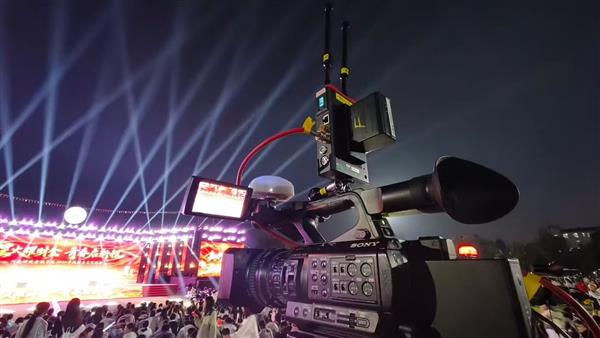
From freshman galas to anniversary ceremonies, sports days and graduation concerts,CRYSTAL VIDEO Thunder PRO-Duois quietly becoming the standard issue for campus production teams.
If your next event has you losing sleep over cable runs — or over what happens the moment the camera turns away —get in touch. We'll send you the same multi-camera deployment plan that carried this gala, tailored to your campus.
